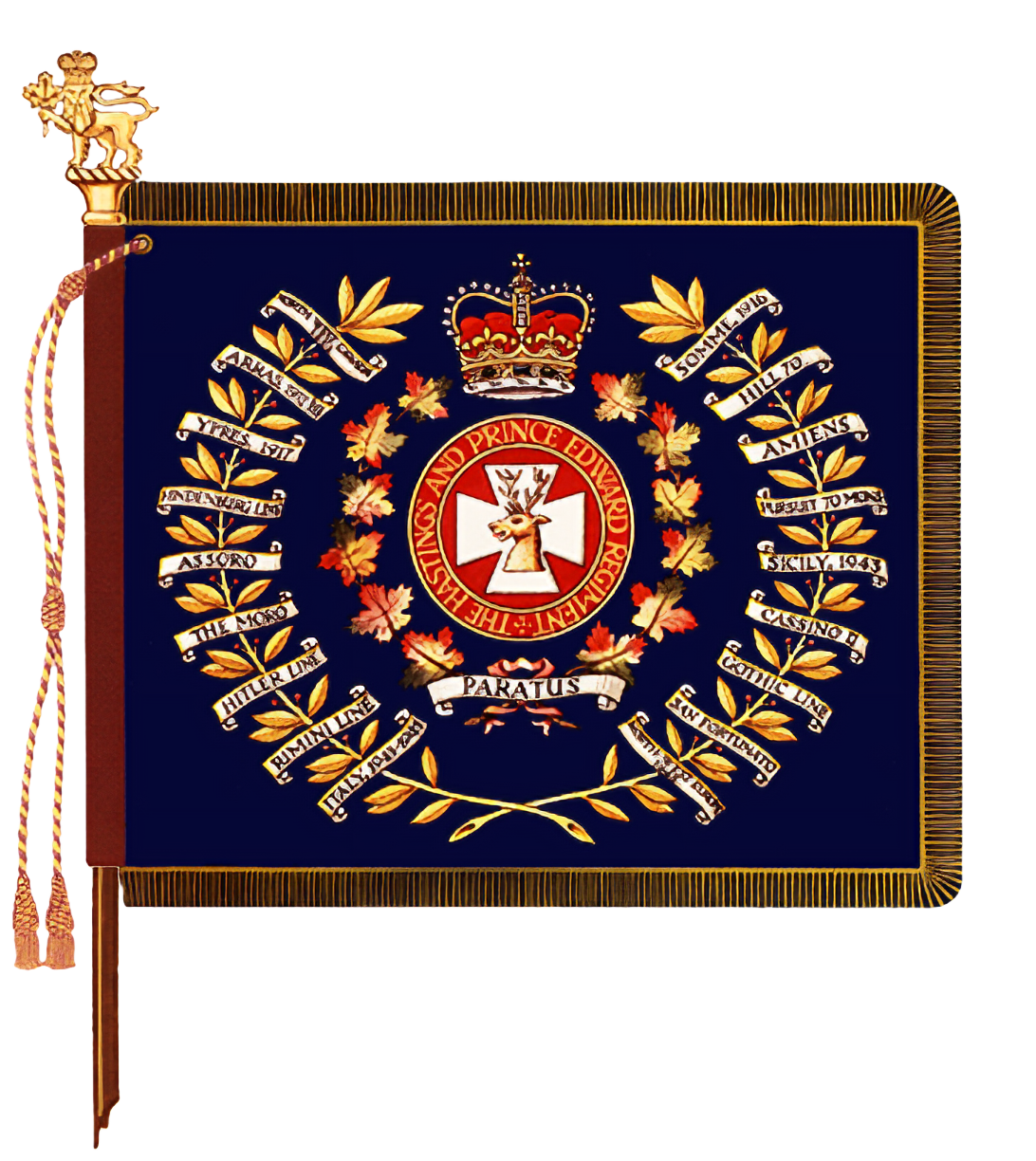
Italian Mainland Campaign
September 3rd 1943 - December 20th 1944
Landing in Italy
The Regiment crossed the Straits of Messina on 03 September 1943 as part of the 1st Canadian Infantry Brigade in the second wave of Canadians to land on the toe of Italy. No resistance from the Germans had been met, and the Italian populace greeted the Allied soldiers warmly. This landing gave The Regiment another Battle Honour, Landing at Reggio. The next few weeks were spent patrolling the mountainous regions of southern Italy until, with the fall of Naples to other Allied troops, the drive to Rome began.
On 01 October 1CIB was tasked with assaulting the hills and valleys around Motta Montecorvino, to cover the advance of the army northwards. This was the first time Canadian soldiers met a change in German tactics – fierce resistance, then rapid withdrawal to another dominant feature. For three days the Regiment pushed into the inhospitable hills to the north, mostly at night and in the rain until securing their objective. Motta Montecorvino became the next Battle Honour.
After a week of rest and consolidation, 1CIB was ordered on 11 October to seize the town of Campobasso, which controlled the roads and valleys for several kilometers around. The Regiment went into action without their second-in-command, Major AA Kennedy, who lost his way on the 13th while trying to contact the RCR and was taken prisoner. He escaped soon after and spent the next three weeks behind enemy lines in the mountains east of Rome until he met with an American post. The Brigade entered Campobasso on the 14th only to find the Germans had left. Campobasso was added to the Regiment’s list of Battle Honours. Veterans might remember it better as “Maple Leaf City” for much leave was enjoyed there over the next ten days.
1CIB advanced on 24 October to a line between the towns of Torella and Molise, about a kilometer apart but on a ridge commanding the valley below. The Regiment was tasked to take Molise, four kilometers away and after a night march cross-country in thick fog and driving rain they took the town on the 27th. For their actions, the Regiment was awarded the Battle Honour Torella.

Amphibious DUKWs loaded with men and equipment, enter the water at Messina in Sicily to cross to the Italian mainland.
Soldiers of The Hastings and Prince Edward Regiment advance through Motta on 2 October 1943
The Moro & San Leonardo
The Allies spent November resupplying and preparing to move towards the north. On 03 December the 1CIB advance resumed, until stopped by strong resistance based on the north side of the Moro River. Initially sent across the river on the 5th as a diversionary attack, A Company had to withdraw that night in the face of superior small-arms fire. Major AA Kennedy (newly returned from his POW time) led the unit in a river crossing that met opposition but managed to establish a bridgehead. As no fire support could get across the river, the men held on all night. What started as 1st Division’s diversion turned into the only successful crossing of The Moro, another Battle Honour but referred to in Farley Mowat’s book as the “River of Blood”.
As the 1st Division spread north, the Germans launched a counterattack against the bridgehead carved out by the Regiment. Located beside the Hasty Ps was the Royal Canadian Regiment (RCR), and both were preparing to move towards San Leonardo. The German reserves were sent in through olive groves on 08 December against well dug-in Canadian positions and withdrew the next day after suffering heavy losses. San Leonardo was added to the list.
The Gully was about one kilometer long. Surrounded by steep cliffs, it was a heavily defended natural obstacle to tanks blocking the path to Ortona. The Regiment had been in constant contact with the enemy for six days now, and the next ten would secure this as another Battle Honour. Ferocious firefights and constant movement saw 1CIB advance. After a final artillery barrage, the 1st Division pushed the enemy out of the hills on the 19th.
Riflemen of the 48th Highlanders of Canada take cover during German counterattack north of San Leonardo, 10 December 1943
The Hastings and Prince Edward Regiment on the Italian Mainland
Ortona & The Gustav Line
The seaside town of Ortona was next. The wet, cold weather added to the discomfort of the troops advancing on the Germans who refused to cede a single building. Street fighting was new to the Canadians who called the town “Little Stalingrad” in reference to the destructive fighting in that Russian city. The tactic of blowing a hole through a wall shared by two buildings and advancing through that breach was named “mouseholing” but led to the advancement of the Canadians. The battle was a brutal nine-day fight that led to many Canadian casualties, until the Germans withdrew on the 28th. Christmas that year was, in Mowat’s words like “…any day to be survived and forgotten if luck and the Gods of war were on your side.” The well-earned Battle Honour Ortona will not be forgotten.
From 05 October 1943 to the end of April 1944 the Regiment and the rest of the 1st Division remained around Ortona but were in action daily, while dealing with shortages of ammunition, replacement parts and troops, with constant inclement weather and patrolling while the high command was turning its sights to the Normandy landings yet to come.
With the return of spring and the warm April sun came the return to the advance to Rome. On the 21st the Regiment left Ortona to the western side of Italy. On the evening of 11th May the second battle around Cassino, later to be called CASSINO II began with an assault on the Gustav Line, ending 8 days later. The Regiment aided in a huge deception plan to let the Germans believe the assault was coming from a different direction – a plan which met with great success. Allied forces pushed through the Gustav Line after a shaky start, with the Regiment providing much firepower on a flank for advancing forces in the center of the assault. The Germans withdrew rapidly to the Hitler Line, fortifications erected in the Liri Valley. Thus, two more Battle Honours joined the list.
Canadian soldiers accompanying a Sherman tank in the streets of Ortona
Treating a wounded Canadian soldier in Ortona, Italy. (Library and Archives Canada Photo, MIKAN No. 4542728)
Liri Valley & The Gothic Line
The battle of the LIRI VALLEY ran from 18th to 30th May. It is referred to as the beginning of the final battle for Rome. On 16th May the Hasty Ps along with the rest of the 1st Brigade of the 1st Canadian Division relieved the 21st Brigade of the 8th Indian Division near Pignataro, Italy. From 21 to 24 May, they were in constant contact with the German Forces manning the Hitler Line. The most savage day and the day in which the gallantry of the officers and men of The Regiment was in great evidence occurred on 23 May however, in those three fierce days of combat, sometimes hand to hand, the officers and men of The Regiment won five awards for gallantry. In those three days The Regiment inflicted heavy casualties on the German defenders and took over 325 prisoners of war. The cost was high as The Regiment lost 17 killed in action and 29 wounded. The Battle Honour of Hitler Line was only part of the larger battle of the Liri Valley, the 12-day drive by the Allied army through heavily defended geographical features that favoured the enemy but on 30 May the Germans were gone. LIRI VALLEY was entered on the books as another Battle Honour.
After a 90-day period to rest and regroup the Regiment was sent west on 25 August as part of a swing in Allied strategy. Thus began the month-long battle to break the 320-kilometer wide by 16 kilometer deep heavily defended GOTHIC LINE north of Florence. Slow advances against a determined enemy meant a hard go but the Regiment persevered, adding more Battle Honours to its count. A series of small-scale skirmishes, often fierce and confused followed against a series of positions. First was the Misano Ridge atop which the village of Misano was captured by the Regiment on the 3rd, while the rest of the ridge fell to units of 1CIB. Soon after the rainy season arrived, and mud was everywhere.
1st Canadian Corps relieve the Indian Division and maintain the advance in the south half of the Liri valley, 16 May, 1944
Churchill tank of 1st Canadian Armoured Division advancing towards the Gothic Line, 26 August 1944.
The Rimini Line & Lamone Crossing
Then came the assault on the RIMINI LINE, a part of the larger Gothic Line defences. The next battle saw the Regiment come under command of 3rd CIB for an advance on the village of San Fortunato atop another ridge. A night attack with tank cooperation but under heavy shelling on the evening of 18 September saw some gains, but the tanks withdrew due to losses and low ammunition. The Regiment dug in and held until the 20th when the enemy withdrew. Many prisoners were taken, and more Battle Honours would grace the Regiment’s record. With the fall of San Fortunato, and pressure on the German defences along the Rimini Line, the Germans retreated the next day.
Bulgaria Village was a large skirmish that turned into a 3-day battle. Before dawn on 13 October the Regiment launched an assault on the village, where every rooftop held at least one German machine gun. The village was at a crossroads for a main resupply route, so was not going to go down without a fight. And fight they did, until after the village was almost totally destroyed and fell on the 20th.
The LAMONE CROSSING from the 2nd to the 13th of December met with a failed first attempt, when the Regiment and the RCR attempted to establish a beachhead across the river on the 2nd but were repulsed with heavy casualties, some caused by friendly artillery fire. On the night of the 10th, the Regiment resumed the advance with success, crossing the river and moving towards their next objective – the Naviglio Canal. As Canadian forces crossed the Canal they were soon cut off by superior forces. The bridgeheads began to crumble, and B Company, HAST & PER was overrun at great loss. Continued pressure by the Allies on the canal saw resistance cease on the 15th. Immediately the Regiment was thrust into another canal crossing at Fosso Vecchio with no chance for replacing their losses at Naviglio. 1CIB put a bridgehead across this canal, but an immediate counterattack pushed them back over the water. This position would not be taken until the 20th, but it did earn the Regiment this Battle Honour.
Ruins of railway station, Rimini, Italy, September 1944
‡ With notes from LCol (ret’d) HL Simpson, CD; from LCol GWL Nicholson, The Canadians in Italy; Volume II, 1943-1945; from Colonel CP Stacey, The Canadian Army 1939-1945; and Farley Mowat, The Regiment.
Infantrymen of The 48th Highlanders of Canada advancing towards the Gothic Line near the Foglio River
For all the actions, trials and tribulations the Regiment endured and accomplished, it was awarded the final Italian Battle Honour ITALY 1943-1945.