Symbols & Traditions
Symbols & Traditions
Honouring the Regiment's customs & legacies
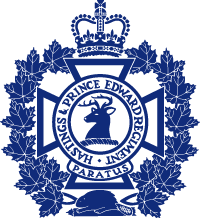
The Regimental Badge
The nine maple leaves on each side was the number of Canadian provinces when the Regiment was formed in 1920, and the beaver (from the badge of the former 16th Prince Edward Regiment) represents service to Canada, and the crown, service to the Sovereign.
The cross commemorates the former 49th Regiment "Hastings Rifles", as does the stag's head, which is a symbol of the region in which the Regiment is based. The royal blue is the official facing colour of the Regiment, the gold represents both the brass origins of the equipment badge and the other Regimental colour adopted in 1934 with the alliance with The Royal Sussex Regiment of the British Army - now, through amalgamation, The Princess of Wales's Royal Regiment.
The scarlet (or red) commemorates the Regiment's service with the 1st Canadian Division in both world wars and is the traditional colour of the army and the infantry in particular. "HASTINGS and PRINCE EDWARD REGIMENT" is a form of the Regimental title, and "PARATUS" (Prepared) is the motto of the Regiment.
The Regimental Colours
The Regiment was first presented with Colours by LGen Sir Archibald Macdonnel and consecrated by the Right Reverend John Lyons, Lord Bishop of Ontario on 14 October 1934 at Picton. The Colours are kept in glass cases in the Combined Senior Ranks’ Mess at Battalion Headquarters in Belleville.
In 1960 the Regimental Colour was stolen from the Mess and despite all efforts was never recovered. On 17 May 1964 the Regiment was presented with new Colours by the Lieutenant-Governor of Ontario, the Honorable W. Earle Rowe, and consecrated by the Command Chaplain, LCol J. Anderson.
The old Queen’s Colour was deposited with due ceremony in St Mary Magdeline Anglican Church, Picton on 04 October 1964 for safekeeping in perpetuity for the Regiment. The empty Regimental standard was also deposited alongside the Queen’s Colour.
The original Battle Flag was made by the crew of HMS Glengyle which carried the 1st Battalion to the Sicily landings. The Battle Flag was flown from the ship’s mast during the landing and later carried ashore with the Regiment. The Battle Flag was always flown at BHQ and had to be replaced often because of enemy shell fire. The current Battle Flag is kept in the Mess and is the personal responsibility of the Regimental Sergeant-Major. It is present at all Regimental parades.
Colours of Regiments which have been absorbed with the Regiment’s own Colours are deposited in the following churches:
Midland Regiment: St Mark’s Anglican Church, Port Hope
Durham Regiment: St Mark’s Anglican Church, Port Hope
Argyll Light Infantry: St Thomas’ Anglican Church, Belleville (destroyed by fire early 1970s)
16th Prince Edward Regiment: Picton United Church, Picton
Northumberland Regiment: St Peter’s Anglican Church, Cobourg
49th Hastings Rifles: Being a Rifle Regiment, the Battle Honours are carried on their drums and they do not have Colours. Similarly, artillery units’ guns represent their Colours.
Regimental Mascots
Little Chief
The first mascot was a pewter Indian, almost four meters tall who stood proudly over the Canning Factory in Picton, which served as a temporary barrack for the Regiment in 1939. Shortly before the Regiment left for the UK in December 1939, “Little Chief” was liberated and taken to Maida Barracks, Aldershot, England where he was packed in unit transport and taken to France. Unfortunately, the Regiment had to evacuate very rapidly, leaving unit transport and Little Chief, who was buried in what was thought to be a safe place. Despite many wild stories of his whereabouts, he has not been seen since.
Chief Petawawa-Much
To replace "Little Chief," the 2nd Battalion commissioned Mr. Abe Patterson, a renowned Pembroke carver, to create the 2.5-meter solid pine Indian which currently lives at Battalion Headquarters' Mess. However, sending the new mascot to the 1st Battalion was a challenge. First, he was shipwrecked when the navy ship in which he was travelling ran ashore in the St Lawrence River, then he was lost for some months in a Halifax dockyard. Ultimately, he had to cross the Atlantic in a private stateroom due to limited space. In Betchworth, he was warmly embraced as Little Chief's replacement, but his painted headdress and loincloth have since faded. During the Regiment's service in Sicily and Italy, he was stored away but was finally brought home with the Regiment, where he attends all Regimental functions.
Son of Little Chief
In 1951, NATO was formed to provide a defence force capable of protecting Europe from any possible onslaught from the East. Canada responded by contributing to the 27th Canadian Infantry Brigade. The Regiment manned a company which became part of the 3rd Canadian Guards. This small wooden Indian, about 1.5 meters tall, was presented as part of the Regimental contribution and served with them in Germany. Eventually, he returned to the Regiment and after many years of service in the commanding officer’s office, he has now become the mascot of the Regimental Cadet Corps in Belleville. In 1954 a small-scale model of Little Chief was sent to the Royal Sussex Regiment.
Regimental Marches
Military marches and bands have played a crucial role in history by fostering camaraderie and unity among soldiers during challenging times. The stirring rhythms and melodies not only boosted morale but also served as a symbol of strength and solidarity, reminding troops of their shared purpose and determination in the face of adversity.
Regimental Quick March ‘I’m Nintey Five’
Sussex By The Sea
Now is the time for marching.
Now let your hearts be gay,
Hark to the merry bugles
Sounding along our way.
So let your voices ring, my boys,
And take the time from me.
And I’ll sing you a song
As we march along,
Of Sussex by the sea.
CHORUS:
For we’re the men from Sussex,
Sussex by the sea.
We plough and sow and reap and mow
And useful men are we.
Whoever you may be, you may tell them all
That we stand or fall for Sussex by the sea.
Good old Sussex by the sea.
You may tell them all that we stand or fall
For Sussex by the sea.
Far o’er the seas we wander,
Wide through the world we roam.
Far from the kind hearts yonder
Far from our dear old home.
But ne’er shall we forget, my boys,
And true we’ll ever be,
To the girls so kind
That we leave behind
In Sussex by the sea.
For We Are Hasty Ps
(to the tune of Lili Marlene)
Let’s sing a song, boys, sing it loud and loud.
Sing it of the Regiment,
of which we are so proud.
We can fight, and we can sing,
So, raise your voices, let them ring.
For we are Hasty Ps,
For we are Hasty Ps.
Let’s sing a song, boys,
of those who’ve gone before.
We’ll not forget them, when the fight is o’er.
And may they find, through God’s good grace
Eternal peace, a resting place.
For they were Hasty Ps,
For they were Hasty Ps.
Let’s sing a song, boys,
for those still in the game.
Driving Tedesci back from whence they came.
While there remains one single Hun,
we know our duty is not done.
For we are Hasty Ps,
For we are Hasty Ps.
Regimental Prayers
When ‘neath the rumble of the guns,
I lead my men against the Huns,
It’s then I feel so all alone, so weak, so scared,
I often wonder how I dared
Accept the task of leading men.
I wonder, worry, fret, and then – I pray,
Oh God, who promised oft
To humble men to lend an ear,
Now in my troubled state of mind
Draw near, Oh God, draw near
Make me more willing to obey,
Help me to merit my command,
And if this be my fatal day,
Reach out, Oh God, Thy helping hand
And lead me to thy Promised Land.
These men of mine must never know
How much afraid I really am,
Help me to lead them in the fight
So they will say He was a man.

♦
Please God, give me,
Courage to do my duty,
Endurance to keep on doing my duty,
Generosity that I may not reckon the
cost of doing my duty.
♦
Official Regimental Prayer
Prayer Before Battle
Composed by Major Alex Campbell, Officer Commanding A Company, near Ortona, Italy; he was killed on Christmas Day 1943.
The White Battalion
During the Second World War, the Overseas Battalion of the Canadian Active Service Force was numbered the 1st, while the Reserve Army Battalion in Canada was numbered the 2nd. Within the Regiment, a tradition arose around referring to fallen comrades, where saying “Transferred to the White Battalion” became used instead of saying a soldier died.
This battalion was given no number, for it is always first in precedence, and persists to this day to refer to those Hasty Ps who have been killed or passed away. The White Battalion is acknowledged at all Regimental dinners and functions, and a symbolic transfer of Battalions is performed at funeral services of members.
The first members of the White Battalion were the 342 officers and men who were killed in action or died of wounds sustained during service with the 1st Battalion during the Second World War. Also included are the many men who served in the 1st Battalion but ultimately went to other units - several Hasty Ps died after transferring to special units, such as the First Special Service Force - as well as deceased veterans and members of the peacetime elements of The Regiment after VE Day.
“We had a saying, ‘Once a Hasty P, always a Hasty P’. Therefore, even when dead, he had to be a part of The Regiment.”
- Colonel Duffy
The White Battalion is the final posting for all Hasty Ps. There are no ranks in the White Battalion; death is the great equalizer.
Padre Goforth Window
In June 1963 a special stained-glass window was placed in the Protestant Chapel of the Royal Canadian School of Infantry at Camp Borden. It was donated by Hasty P’s in memory of their beloved Padre, Major G.F. Goforth, MC who became a legend as wartime Padre for The Regiment.
This chapel is now known as the Protestant Trinity Chapel at Canadian Forces Base Borden.
Trinity Chapel at CFB Borden
The Regimental Chair
In the Officers’ Mess at Canadian Forces Base Borden was a very fine heavy leather chair given by the Regiment to the Mess when the Combined Arms Battle School was at that Base. The Chair was relocated to the Combat Arms School when the school was formed at CFB Gagetown in the early 1970s. It is the right of any visiting officer to request to be seated in the chair of their regiment when eating at this Mess. A photo of this chair hangs in the Belleville Senior Ranks’ Mess.
Ceremonial Accessories
The Commanding Officer’s Sword was presented by LGen HD Graham in April 1968 to be carried by the Commanding Officer on all ceremonial parades. The sword is retained by the Commanding Officer during his term.
The Adjutant’s Sword is kept in the Regimental Museum. It was presented by Captain Art Norrington at the end of the Second World War and is carried by the Adjutant on ceremonial parades. Captain Norrington was the Adjutant of the 1st Battalion in the 1930s, and in England in 1939.
The RSM’s sword was originally presented by RSM C. Burkitt of “B” Company in Madoc. It is handed to each new RSM and the name of the holder is inscribed upon it.
The RSM’s stick was presented to RSM Stan Downs by Major Wallbridge who was an officer in the Regiment during the Second World War. The stick originally belonged to Major Wallbridge’s father who was an officer in the 49th Hastings Rifles. The names of successive RSMs are inscribed on the stick.
The RSM’s brass badges of rank were given to RSM Angus Duffy in 1940 by LCol Sutcliffe, who was later killed in Sicily. These badges are handed down from RSM to RSM.
Drill Floor Plaque
On 15 February 1965, the same day that Canada officially proclaimed the Maple Leaf Flag, the 8-foot square plaque on the south wall of the Belleville Armoury was unveiled by Mrs Constance Donnan (wife of LCol BC Donnan). The plaque is made from a large crown which used to hang in the Norwood Armoury and a shoulder flash previously outside the Belleville Armoury. The red background is related to the service of the Regiment as part of the 1st Canadian Infantry Brigade in the Second World War. On the background are shown the 18 Battle Honours inscribed on the Regimental Colour. All ranks pay respect to those who have served in the Regiment by saluting the plaque when they enter the Armoury.