Northwest Europe Campaign
April 3rd – September 5th 1945
Landing in The Netherlands
On 11 March 1945 the men of The Regiment boarded transport ships on the west coast of Italy near Pisa and sailed to Marseilles, France. From 12-20 March they drove in convoy across France to a concentration area in Westmalle, Belgium. The Regiment crossed into The Netherlands on 03 April 1945 to a staging area in the Reichswald Forest on the German/Dutch border.
The German 25th Army Group in the Netherlands under General Blaskowitz had been cut off from Germany. 1st Canadian Division’s plan was to drive east from Zutphen and cut Holland and the 25th Army Group in two. The plan for the campaign in the west of Holland called for 1st Canadian Infantry Brigade (the Royal Canadian Regiment, the 48th Highlanders, The Hastings and Prince Edward Regiment) to advance east along the axis of the Apeldoorn-Deventer railway to the airfield at Teague while 3rd Canadian Infantry Brigade (The Royal 22nd Regt, the Carleton and York Regt, and the West Nova Scotia Regt) were directed south of Apeldoorn to prepare an assault crossing of the canal in the event 1st Brigade ran into difficulty. On 10 April Lieutenant-Colonel George Renison (48th Highlanders) assumed command of The Regiment from the acting CO, Major Allan Ross.
A Canadian convoy passes through Holten, The Netherlands, 9 April, 1945
Operation Cannonshot
Code named Operation Cannonshot, the assault was launched at 3:30 p.m. on 11 April after a delay of 24 hours. The enemy appeared to be totally surprised. Apparently ignorant of 1st Division’s presence they assumed that the attack would come from 3rd Division at Deventer. The initial opposition came from small German battle groups built around one or two self-propelled guns.
The Regiment remained in this staging area out of contact with the enemy until 12 April when they were ordered to take up positions near the town of Zutphen approximately 18 kilometers southeast of Apeldoorn. They crossed the Ijssel River between Zutphen and Deventer around 1230hrs and moved to Hoven where they dug in for the night. On 13 April the unit headed out for the village of Twello, with Tactical HQ set up in the village railway station. They were ordered to secure a crossroads west of Teuge accompanied by tanks from the 1st Hussars. Action varied from sporadic resistance to full out, fierce fire fights as The Regiment came up against 953rd Grenadier Regiment of the 361st Volksgrenadier Division fighting now with a fierceness one step removed from maniac fury. The advance seemed impossibly fast; no mopping up, but picket and by-pass became the order of the day. By nightfall the unit was in the vicinity of Achterhoek, seven kilometers east of Apeldoorn with its front line four kilometers east of the Apeldoorn Canal. Periodic fighting carried on throughout the night. Total POW captured was 242. Five Hasty Ps KIA, twenty-four wounded.
At 0200hrs 14 April the unit got within 50 meters of a bridge crossing a canal on the outskirts of Apeldoorn, just as the Germans blew it. During the day progress was slow as engineers attempting to repair the bridge were sniped at from buildings on the far side of the canal. 111 POWs taken, with five soldiers wounded. On 15 April the unit stayed in situ while the Brigade Commander planned his attack on Apeldoorn. On the evening of 16 April, the RCR and 48th Highlanders passed through the unit and attacked Apeldoorn. The city fell that night.
The morning of 17 April the unit was ordered to pass quickly into the city, capture the Royal Palace at Het Loo and clear the woods to the west. When the unit entered the city the newly liberated Dutch citizens crowded the streets on all sides, shouting and cheering and showering the Battalion with flowers and kisses and enjoying the moment to the fullest but hindering the unit’s progress to no end. Eventually, LCol Renison found it necessary to draw his revolver and fire a couple of shots into the air. The crowd sobered sufficiently to allow the unit to make it through to Queen Wilhelmina’s front yard where the CO set up his Tactical HQ. After the palace was liberated, the unit moved into the woods to the west but encountered strong resistance in the Nieuw Milligen Woods. Most of the enemy were German and Dutch SS using heavy mortars and anti-tank guns at close range.
The Hastings and Prince Edward Regiment of 1st Canadian Division in the bush near Apeldoorn, Netherlands, 19 April 1945.
Officers of The Hastings and Prince Edward Regiment at Battalion Headquarters near Apeldoorn, Netherlands, 19 April 1945
The fighting was fierce but by 2100 hours the woods were cleared, and a subsequent crossroads was taken by another Hasty P attack supported by tanks and flamethrowers. In the end the Germans withdrew. 87 POWs were taken. Seven Hasty Ps KIA with four others wounded.
C4773 Cpl Elwood Finton an original from 1939 was the last Hasty P killed in action in the Second World War. A member of the mortar platoon, he was to be sent home in January 1945 but elected to stay in theatre. He was killed by a sniper; The Regiment got the sniper. Cpl Finton also had a brother in the unit who was captured at the Lamone.
18 April was a relatively quiet day as the unit continued to patrol the area for any enemy. No casualties and 38 POW captured. On the morning of 19 April, the unit having encountered only light resistance was ordered to Elspeet. From 23 April until 06 May the unit staged out of Elspeet conducting several small operations with Dutch partisans. There were the inevitable patrols but basically the unit was at refit and some R&R.
On 04 May news reached the unit that all Germans in Holland, Denmark, and northwestern Germany had surrendered unconditionally to Field Marshal Montgomery. The CO was immediately summoned to Brigade HQ for a conference. On 06 May the unit moved to Amersfoort but was engaged by a German battalion in front of the city who had not yet received official word from its High Command of the cessation of hostilities. No casualties were suffered. Later in the evening assured that the Germans were now aware the war was over for them, the CO moved forward with a protection party of carriers from The Regiment. No problems arose and at 2330hrs 06 May Lieutenant-Colonel Renison met the German Commander at Amersfoort and informed him he would arrive the next day at 0900hrs to accept the Germans’ surrender. Promptly at 0900hrs on 07 May, Lieutenant-Colonel Renison arrived at the German HQ. Later that day the unit received orders that they are being detached to under command of 2 CIB along with the RCR.
IJmuiden
On 08 May Lieutenant-Colonel Renison along with Lieutenant-Colonel Reid of the RCR headed out about an hour ahead of the main body for IJmuiden. Their progress was slow, but they finally reached IJmuiden, went directly to the German HQ where they rousted out the German General and told him how the rounding up of his troops was to be carried out. The CO then took one German officer, his IO, and his interpreter and left to look for billets for The Regiment which they found in Santpoort. The rest of the unit arrived around mid-afternoon and while they settled in the CO met with his RCR counterpart at the German HQ to decide on assignment of tasks. It was decided the RCR would establish arms and equipment dumps, guard the German troops within the fortress, and the Hasty Ps would do the round up, guard the perimeter, regulate passes and escort German convoys etc.
The welcome in IJmuiden was tremendous. The people in the IJmuiden district had had an unhappy time at the hands of the Germans. Their relief and joy at the coming of the Canadians was indescribable. An indication of the suffering they had ensured was evidenced by a common grave of over 400 Dutch civilians, murdered by the Germans over a period. The graves comprised shallow pits, with up to twenty bodies in each pit. Lieutenant-Colonel Renison paraded a company each morning and each afternoon to help dig up and remove the bodies. He stated in this way he could be assured that no one there would ever forget the ugliness of the German actions and never could be told afterwards, as we sometimes hear now, that such atrocities didn’t happen.
The Regiment stayed in the local area until 14 June when they moved to Soest until 01 September continuing the work of disarming the enemy and cataloging equipment. That day the unit moved to Nijmegen where equipment; vehicles and excess clothing were turned in. During this period unit personnel were returned to Canada and an equal number of replacements came into The Regiment. On 04 September the unit was moved by train to Ostend and on 05 September set sail for England. After 22 days at Dunley Hill Farm in Surrey, The Regiment boarded the Ile de France on 27 September and set sail for Canada, arriving back in Belleville on 04 October 1945.
German soldiers entering a concentration area to be disarmed by soldiers of the 1st Canadian Corps, Amsterdam, Netherlands, 9 May 1945
Brigadier J.A. Roberts of the 8th Canadian Infantry Brigade and Major-General Harry W. Foster, General Officer Commanding 1st Canadian Infantry Division, examining a small German two-man "Biber" submarine, IJmuiden, Netherlands, 25 May 1945
No. 1 Provost Company guard German mini-submarines at IJmuiden, Netherlands, 25 May 1945
Historical Notes
In total 7,600 Canadians gave their lives for freedom in the Netherlands. In the month of April 1945, 1191 Canadians were KIA in Holland and 114 in the last five days of the war. The 1st Canadian Division’ actions in Holland saw 506 casualties, over 100 of them fatal, in six days of fighting in and around Apeldoorn. The 1st Brigade (RCR, 48th Highlanders, Hast & PER) lost 184 men.
The population of Holland in 1940 was 8,900,000 made up of 8,460,000 Dutch: 300,000 Frisian, and 140,000 Dutch Jews. From 15 May 1940 to 05 May 1945 the Dutch suffered the following: Resistance fighters killed: 5,500; Civilians killed: 38,000 (18,000 by deliberate starvation); Dutch Jews killed: 102,000. By the end of 1945 only 30,000 Dutch Jews had survived the war.
From 11 to 17 April 1945 40 German officers and 2515 other ranks passed through 1st Division’s prisoner of war cages. In the spring of 1945 reports from the old provinces of Holland including the cities of Amsterdam and Rotterdam indicated that the terrible conditions of the “hunger winter” of 1944 were continuing and the people of western Holland were facing food shortages. More than 18,000 men, women, and children, many of them elderly died of starvation. The Nazi governor, Arthur Seyss Inguart had deliberately created the food shortage in retaliation for the actions of the Dutch resistance (Inguart was found guilty of crimes against humanity during the Nuremburg War Trials and was hanged on 16 October 1946). On 19 April, the Germans agreed to a short truce to allow the Canadians to transport food to the starving Dutch who were in desperate need.
Seventeen Hasty Ps made the supreme sacrifice in Holland. They are buried at the Holten Canadian War Cemetery. Thirty-six Hasty Ps were wounded, and 440 German prisoners were taken.
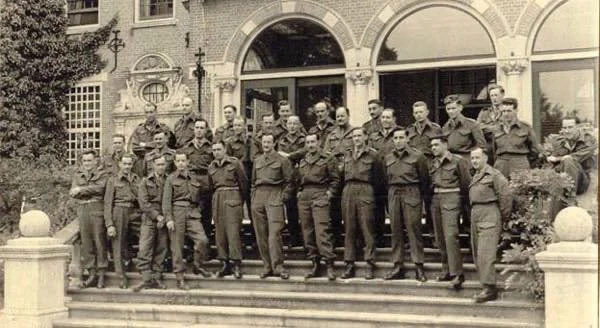
Officers of The Regiment at Duin en Kruidberg in Santapoort in the spring of 1945
‡ From notes by LCol (ret’d) HL “Skip” Simpson, CD
Canadian Army Newsreel No. 103: 1945 in Review (Source: Canadian Army Film Unit/LAC/MIKAN 77708/Newsreel No. 103)
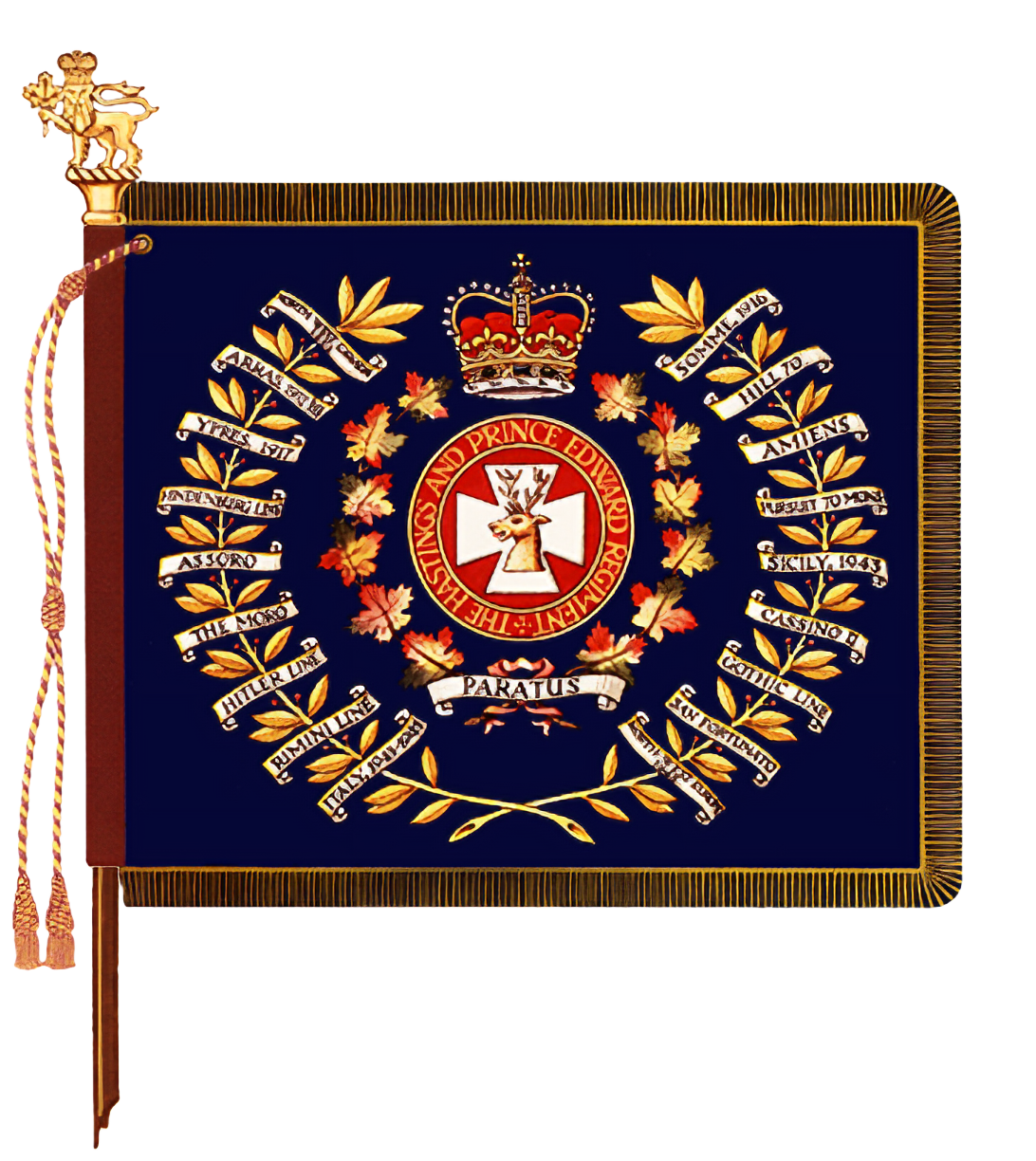
For its actions in Holland, The Regiment was awarded its 29th and 30th Battle Honours of the war: Apeldoorn and North-West Europe 1945.