Sicily Campaign
July 10th – August 17th 1943
Landing in Sicily
At the Casablanca Conference in January 1943, the decision was made to attack Sicily in Operation Husky to eliminate Italy from the war in preparation for an invasion into northwest Europe in 1944. Although Operation Husky would be minor compared to the planned 1944 operation, the success of Husky was vital to ensure the success of what would come to be called “D-Day in Normandy”.
The 1st Canadian Division left the United Kingdom in June 1943 on 92 ships plus naval escorts. En route to Sicily three of these convoy ships were sunk off the coast of Gibraltar, with a loss of 55 Canadians as well as more than 500 vehicles and some artillery. Unfortunately for the Regiment, the ship carrying the unit transport was torpedoed off the coast of Gibraltar and Captain Don Whytock of Madoc, the unit’s transport officer lost his life.
At dawn on 10 July the Regiment along with the Royal Canadian Regiment and the 48th Highlanders landed along the east side of the Pachino peninsula as part of the 1st Canadian Infantry Brigade where they met some resistance from Italian soldiers who were quickly subdued. 1CIB was commanded by Brigadier Howard Graham, a previous CO of The Regiment. The brigade’s axis of advance took it towards the interior of the island where further Italian military resistance was encountered and dealt with on 12 July. The Regiment captured Grammichelle in their first encounter with German soldiers on 15 July, then moved along Highway 124 into ‘Death Valley” towards Valguarnera which city fell after a three-day battle on 19 July.
Landing on the Beach at Pachino, Sicily, 10 July 1943
The leading battalions of 1st Canadian Infantry Division storming onto the beach on the western edge of Pachino Peninsula, the southernmost point of Sicily, 10 July 1943
Assoro
Assoro was a herculean task assigned to the Regiment that some doubted could be pulled off. Atop a jagged mountain peak about 1,000 meters high sat an ancient Norman castle where the occupying German troops had a commanding view of the countryside. The unit’s commanding officer, LCol Bruce Sutcliffe and his Intelligence Officer Captain Cockin moved forward to reconnoiter the area. Soon after a German 88mm shell landed on their position. The CO died instantly, the IO the next day. Command devolved on Major Lord John Tweedsmuir, son of a former Governor General of Canada. Tweedsmuir decided on a bold plan to scale the cliff on its steepest side. At dusk on the 20th the soldiers set off across the countryside to the base of the cliff, then to climb up the heights of the mountain. Dawn of the 21st saw them firmly established behind the surprised Germans, who tried several counterattacks to dislodge the exhausted Canadians. After realizing they had been outflanked, the Germans withdrew on the 22nd. Later it was found that the 15th Panzer Grenadier Division, who the Hasty Ps met there, wrote of their antagonists “In fieldcraft superior to our own troops. Very mobile at night, surprise break-ins, clever infiltrations at night with small groups between our strongpoints.”
A painting by renowned Canadian war artist Ted Zuber entitled “Assault on Assoro’ was commissioned by The Regimental Associations Trust Fund in 1995 to commemorate the 50th anniversary of the return of The Regiment from active service, which was later commemorated in a Canada Post stamp.
The Canadian supply route through the mountains of Italy, c1943
Agira & Regalbuto
On the evening of 24 July, the Regiment launched an attack on the hills around Agira but were beaten back. Over the next three days 1CIB continued pressing home the attack until the Germans withdrew on the 28th. The next day saw 1CIB resume its advance along Highway 121 toward Adrano in continual pursuit of the retreating Hermann Goring Division. Two more days of constant contact with the enemy saw that town fall to Allied troops, including 1CIB on 07 August.
Regalbuto was the last battle the Regiment would be engaged in while in Sicily. Fought over 01-03 August, it was a well-planned attack on a ridge southeast of that town after two previous attacks by other units had failed. An excellent plan of attack combined with sufficient artillery support in the words of Farley Mowat “was probably the most important, if also the most colourless action fought by the Regiment in Sicily…it was fought by men who were at last fully aware of the meaning of war, and who fought with full understanding of it and with consequent skill.” The unit suffered one fatality, but the German forces withdrew in the face of superior opposition.
Infantrymen of The Hastings and Prince Edward Regiment in a Universal Carrier "Katie", used as their secition support vehicle, advancing on Nissoria, Italy, July 1943
2nd Field Regiment firing close to Nissoria, Sicily in July 1943
Historical Notes
Officially forty members of The Hastings & Prince Edward lost their lives in the Sicilian campaign. Starting with the landings at Pachino on 10 July 1943 thirty-nine Hasty Ps lost their lives; thirty-three are buried at Agira, and seven whose bodies were never found are listed on the Memorial Panels at the Cassino War Cemetery in mainland Italy (Captain Whytock, Ptes Caban, Way, Long, McGinty, Cassibo, and Juby). Pte Long was later identified in a German burial ground. Of those killed in Sicily the oldest at 38 was Lieutenant-Colonel Bruce Sutcliffe and the youngest was Private R.V. Smallwood who was 18. In terms of casualties: Assoro -12, Nissoria -16 Valguarnera -7, Pachino - 2, Giarrantana – 1 and Regalbuto – 1. Private N.D. Dwyer, 20 of Peterborough died 22 July 1943 in North Africa of a fractured skull resulting from a fall from a troop train. He was buried at El Alia British Military Cemetery 12 kilometers south-east of Algiers.
In 2013 The Regiment was invited by Mr. Steve Gregory to join in a celebration of the Canadian Army’s participation in the liberation of Sicily which he named Operation Husky 2013. This event marked the 70th anniversary of this event and drew our country’s, and the world’s attention to Canada’s involvement and sacrifices in July and August of 1943.
‡ From notes by LCol (ret’d) HL Simpson, CD; Farley Mowat, The Regiment; and from Colonel CP Stacey, The Canadian Army 1939-1945.
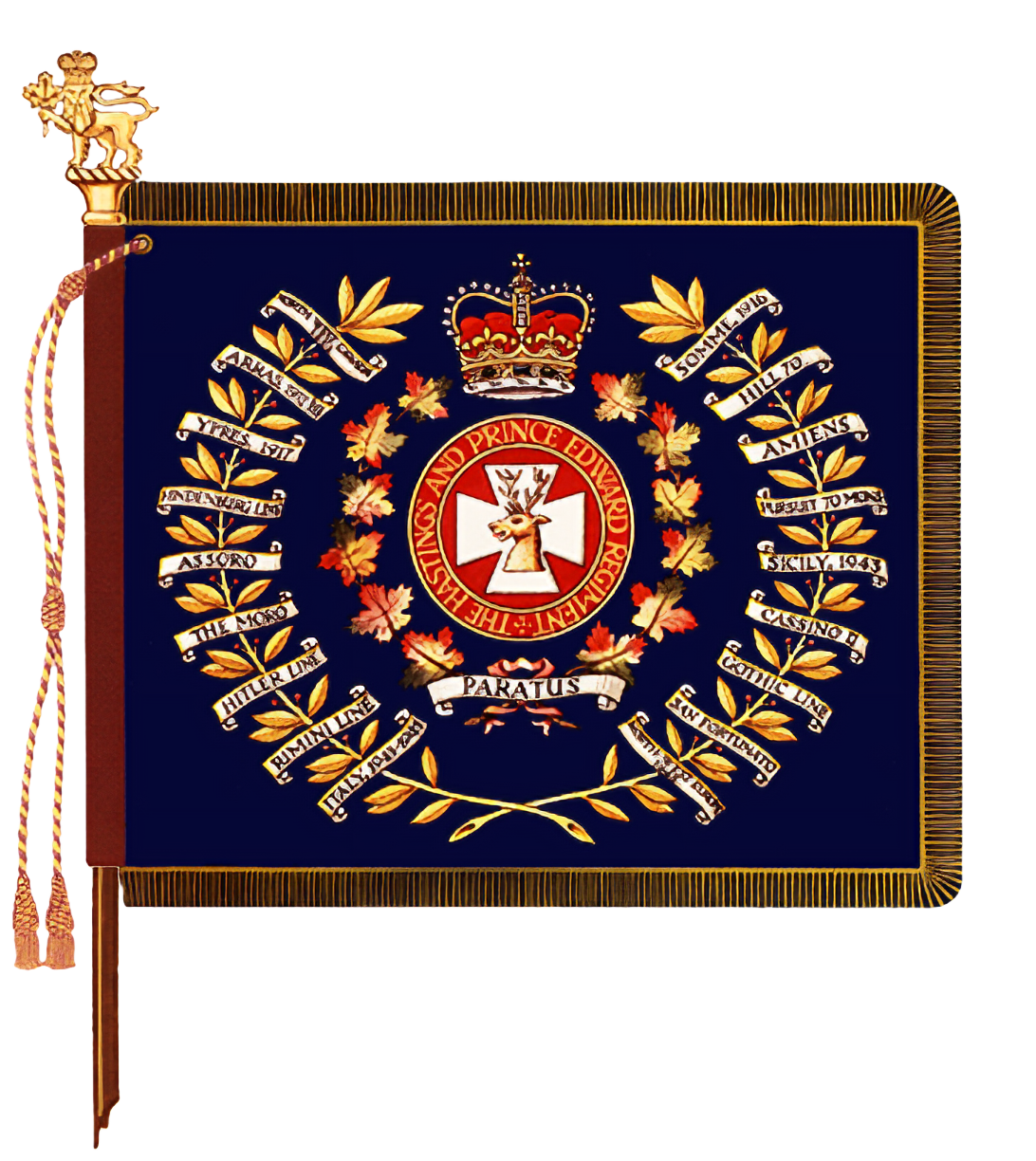
By Canadian Army Order Issue Number 545, published 27 May 1945 the Hasty Ps were accorded the following Battle Honours from this campaign: Landing in Sicily; Grammichelle; Valguarnera; Assoro; Agira; ADRANO; Regalbuto; and Sicily 1943.